










Domestic UK law offers no protection at non gamstop bank transfer casinos
Operators running non gamstop bank transfer casinos lack a UK Gambling Commission licence, meaning British consumer protection rules do not apply to any funds wired there. Under Section 33 of the Gambling Act 2005, providing gambling facilities to consumers in Great Britain without a Commission operating licence is an illegal offence.
| Banking & Regulatory Parameter | UK Licensed Casinos | Non-GAMSTOP Offshore Sites |
|---|---|---|
| Payment Network | Pay.UK Faster Payments and Open Banking | International SEPA or SWIFT wire transfers |
| Average Payout Time | Real-time settlement 365 days per year | Multi-day cross-border correspondent clearing |
| Currency & FX Cost | Direct GBP current account transfers | Foreign currency conversion and wire handling fees |
| Dispute Protection | Free independent ADR referral after 8 weeks | No UK Gambling Commission ADR scheme access |
| Legal Status | Authorised under the Gambling Act 2005 | Illegal to provide facilities in Great Britain |
Every operator licensed by the Gambling Commission has been required to participate in GAMSTOP as a mandatory licence condition since 31 March 2020. Any bank transfer casino non uk operating outside this framework leaves British account holders without statutory ring-fencing or regulatory oversight, whereas players can compare our list of safest bank transfer casinos to see how domestic licensing protects deposits.
Foreign gambling permits never authorise targeting local consumers
An offshore gambling licence issued in another jurisdiction never authorises an operator to offer gaming facilities to residents in Great Britain. The Gambling Commission confirms that cross-border provision remains illegal regardless of where the overseas company is based, so players must verify an active UK licence display before initiating any non gamstop casino bank transfer.
Offshore non-GAMSTOP cashiers use slow SEPA and SWIFT wire transfers
Unlicensed offshore casinos cannot connect directly to the UK Faster Payment System and rely instead on international SEPA or SWIFT wire networks. While Pay.UK has operated the domestic Faster Payment System since 2008 to process real-time sterling transfers, non-UK merchant accounts sit outside this domestic sort code infrastructure.
When a British player initiates a wire transfer to an offshore bank account for gambling, the payment must clear through international IBAN routing rather than local Open Banking rails. Readers looking for immediate domestic settlement can review how an instant bank transfer casino uk processes verified Pay by Bank payments without cross-border delays.
Wire transfers to unlicensed casinos often stall at UK high-street banks
British high-street banks routinely hold, question, or reject outbound wire transfers directed to unlicensed offshore gambling merchants. Financial institutions apply strict compliance screening and transaction limits under Pay.UK rules, alongside enforcing the Gambling Commission credit card prohibition so borrowed funds never enter gambling accounts.
When an international wire triggers an automated fraud or compliance alert, the sending current account holder faces manual security reviews before any money moves. Unlike regulated domestic Pay by Bank transfers, cross-border wires to unverified gaming recipients risk permanent rejection by the bank's risk department.
Merchant screening flags cross-border gambling IBANs automatically
Automated bank compliance filters cross-reference destination IBAN details and beneficiary names against lists of known unregulated gambling processors. If a British bank identifies an unapproved offshore gaming recipient, the transfer is halted immediately to prevent unlawful payment processing and protect the account holder from fraud.
Sending sterling to non gamstop bank transfer casinos adds FX fees
Wiring pounds from a UK current account to non gamstop bank transfer casinos incurs foreign exchange markups and international banking charges because offshore cashiers rarely hold domestic sterling accounts. Although the Gambling Commission confirms that customer gambling winnings carry 0 tax in Great Britain, players still lose a portion of their balance to intermediary SWIFT handling and double currency conversion.
- Outbound SWIFT instruction fees charged by the sending UK current account provider.
- Intermediary correspondent bank deductions taken while the wire transits across borders.
- Exchange rate markups applied when converting sterling deposits into foreign cashier currencies.
- Secondary conversion losses deducted when foreign currency withdrawals return to a UK sort code.
Every deposit converted from GBP into euros or dollars and later wired back into sterling suffers two separate exchange rate spreads. By contrast, players choosing regulated 10 minimum deposit bank transfer casinos transact directly in pounds without paying cross-border wire fees.
Cross-border SWIFT payouts from non UK casinos take several working days
International SWIFT withdrawals from offshore casinos require multiple working days to clear through correspondent banking chains before reaching a British current account. Whereas the domestic Pay.UK network settles payments 365 days per year in real time, cross-border wires pause over weekends and bank holidays while passing through overseas clearing houses. If the wait for a stalled payout turns into pressure to deposit again, the National Gambling Helpline (run by GamCare) can be reached free on 0808 8020 133, 24 hours a day.
Offshore operators also add manual internal pending periods before releasing international bank transfers, stretching total waiting times far beyond domestic standards. Players comparing payout speeds can see how a licensed fast bank transfer casino uses UK Faster Payments to credit withdrawals on the same day.
Official warnings show unlicensed casinos block bank transfer payouts
The UK Gambling Commission warns that illegal non-GAMSTOP websites frequently block bank transfer payouts and expose players to identity theft and fraud. Sending current account numbers and sort codes to an unregulated non-GAMSTOP cashier leaves personal banking details without domestic payout recourse, though players can report unlawful sites confidentially to the Commission. For regulated domestic alternatives, see our guide to the safest bank transfer casinos operating under British oversight.
Unregulated cashiers often set unattainable withdrawal thresholds
Unregulated non-GAMSTOP operators frequently set minimum bank transfer withdrawal thresholds so high that they become unattainable for ordinary account holders. When a wire transfer payout requirement exceeds the player's actual balance, deposited sterling funds remain trapped inside the non-GAMSTOP cashier.
Players wiring funds to offshore sites lose independent dispute rights
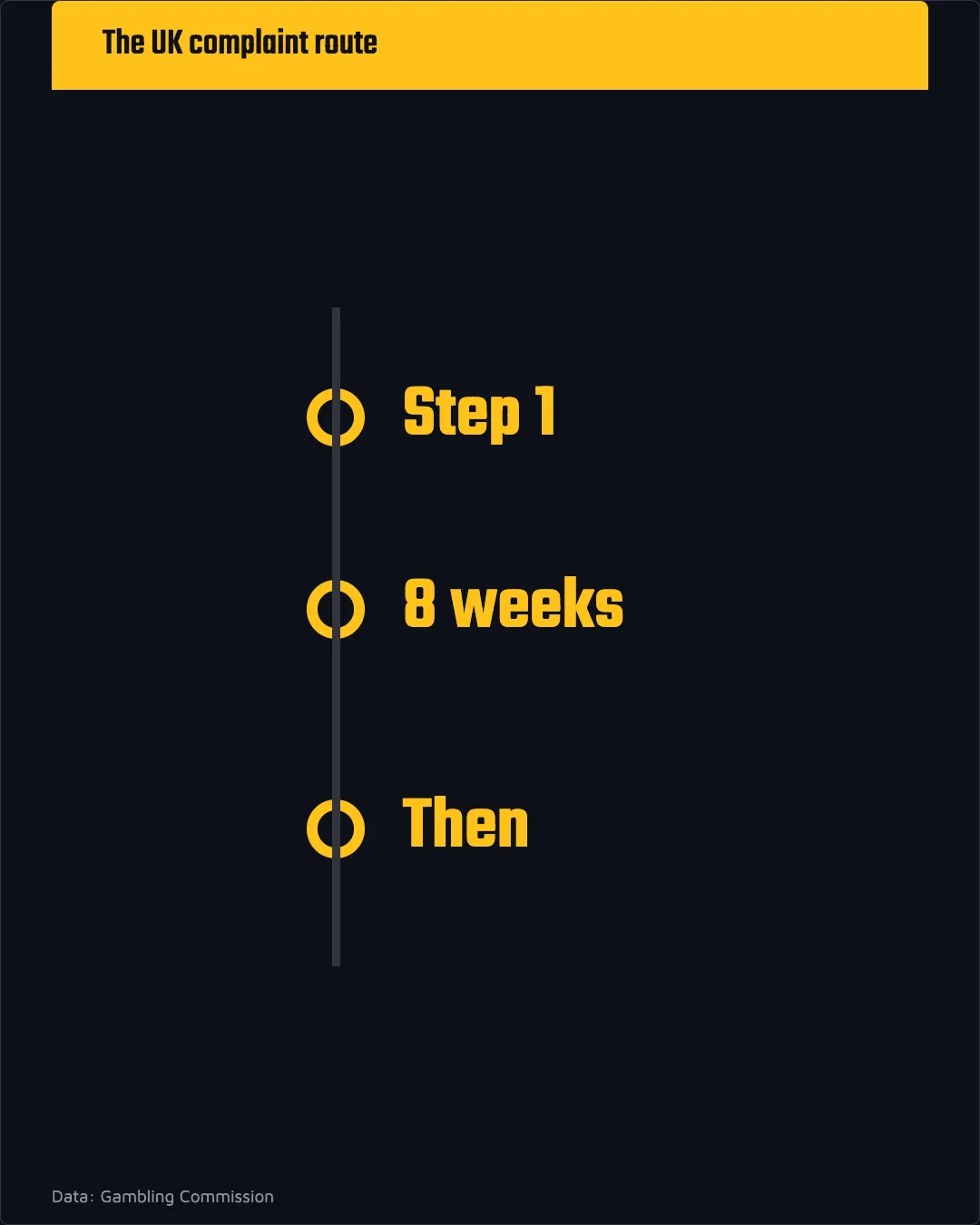
Customers who wire money to unlicensed offshore casinos forfeit access to UK Alternative Dispute Resolution (ADR) providers if a bank transfer withdrawal goes missing. At a British-licensed operator, a player must first complain directly to the gambling business and can escalate unresolved payment disputes to a free, independent ADR scheme after 8 weeks.
While approved ADR bodies do not handle general customer service issues, they adjudicate contractual payout disputes for regulated accounts. Unlicensed sites operate outside this mandatory framework, leaving British players with zero independent recourse when an offshore cashier withholds a bank wire.
Winnings paid out by bank transfer casinos are tax-free for UK players
Winnings paid out by bank transfer casinos are tax-free for UK players: the Gambling Commission states that gambling winnings are tax-free for customers regardless of the amount won, because tax is levied on operators' Gross Gambling Yield instead. HMRC's Business Income Manual adds the basic position that betting and gambling, as such, do not constitute trading.
The sum that reaches a British current account can still shrink on the way. At non gamstop bank transfer casinos the loss comes from banking rather than tax: sterling sent abroad picks up FX fees, and a payout converted back into pounds can lose value a second time on the exchange rate. Because a cross-border wire clears through correspondent banking chains over several working days, the rate applied on arrival can differ from the one shown when the withdrawal was requested.